By Michael Greger, M.D.
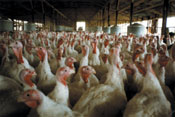 Photo courtesy of Farm Sanctuary |
Animal agriculture is not just a public health hazard for those that consume meat. In fact, the single worst epidemic in recorded world history, the 1918 influenza pandemic, has been blamed on the livestock industry.[1] In that case, the unnatural density and proximity of ducks and pigs raised for slaughter probably led to the deaths of 20 to 40 million people across the world.[2] Since then, the raising of pigs and poultry has resulted in millions more human deaths from the 1957-58 Asian flu, the 1968-69 Hongkong flu and the 1977 swine flu.[3] All of these influenza strains seem to have arisen in the same region of southern China where intensive systems of animal agriculture have become a breeding ground for new killer viruses.[4]
For centuries, the Guangdong province of China has had the world's largest concentration of humans, pigs and fowl living in close proximity.[5] In this environment, pigs can become co-infected with both human and avian (bird) strains of influenza. When this happens, a deadly gene swapping can take place, in which the lethality of viral strains rampant in the Chinese poultry industry[6] can combine which the human transmissibility of the human strains to create new mutated flu viruses capable of infecting and killing people on a global scale.[7]
Other viral threats besides influenza have also escaped from Southeast Asian livestock operations. In 1999, a new virus, now known as the Nipah virus, jumped from pigs to humans in Malaysia, infecting pig breeders and killing about a hundred people before it was stamped out.[8] In the Southern Chinese province of Guangdong, battery chickens are sometimes kept directly above pig pens, depositing their waste right into the pigs' food troughs.[9] It may come no surprise, then, that Guangdong is thought to have been ground zero for the deadly SARS virus as well.[10] The Severe Acute Respiratory Syndrome (SARS) virus is just the latest in a string of human tragedies traced back to our appetite for animal flesh.
According to the World Health Organization, SARS, which has already infected thousands worldwide, could become the "first severe new disease of the 21st century with global epidemic potential."[11] And experts are again blaming intensive animal agriculture.[12,13,14,15] According to China's equivalent of the Centers for Disease Control, the first people to succumb to the SARS virus were bird vendors and chefs, who had been in close and continued contact with chickens, ducks and other birds.[16]
Scientists have identified SARS as a coronavirus, a class of viruses well known to the livestock industry.[17] Coronaviruses are found in many feedlot cattle who die of pneumonia and are responsible for the respiratory disease known as shipping fever in cattle stressed by transport.[18] There's currently a new mutant strain of coronavirus causing outbreaks of a contagious pneumonia on pig farms in several countries.[19] Preliminary work, though, suggests the SARS virus is more related to the one that causes lung infections in chickens.[20]
The concentration of animals with weakened immune systems in unsanitary conditions seems inherent to factory farming. As intensive livestock operations continue to spread worldwide, so will viral breeding grounds.[21] Moving away from intensive animal agriculture and towards more sustainable plant-based methods of production may benefit the health of the planet and its inhabitants in more ways than we know.
[1] Daily GC, Ehrlich PR. Development, Global Change, and the Epidemiological
Environment. Stanford, CA: Stanford University; 1995. Paper #0062.
[2] Kiple KF, editor. The Cambridge World History of Human Disease. Cambridge:
Cambridge University Press; 1993.
[3] The Straits Times (Singapore) ,March 21, 2003.
[4] Ibid.
[5] Time, April 7, 2003.
[6] The Straits Times (Singapore), March 21, 2003.
[7] Courier Mail (Australia) ,April 12, 2003.
[8] South China Morning Post, April 9, 2003.
[9] Sydney Morning Herald, April 7, 2003
[10] Time, April 7, 2003.
[11] The Atlanta Journal and Constitution, April 12, 2003.
[12] TB & Outbreaks Week, April 15, 2003.
[13] The Toronto Sun, March 28, 2003.
[14] New Scientist, April 03, 2003.
[15] Courier Mail (Australia), April 12, 2003.
[16] The Michigan Daily, April 09, 2003.
[17] New England Journal of Medicine, April 10, 2003.
[18] Santa Fe New Mexican (New Mexico), April 6, 2003.
[19] Ibid.
[20] New Scientist, April 03, 2003.
[21] Time, April 7, 2003.
Dr. Greger is a general practitioner specializing in vegetarian nutrition. He is author of Heart Failure: Diary of a Third Year Medical Student and has contributed to a number of books on veganism and food safety issues. Dr. Greger is a graduate of the Cornell University School of Agriculture and the Tufts University School of Medicine.
Visit Dr. Greger's website at http://www.VeganMD.org.