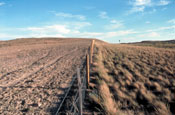
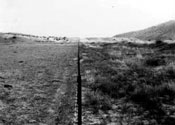
"One friend reports having a flash of understanding when he stood by a fence that separated grazed and ungrazed portions of the same creekbed. One side was lush and verdant. The other side looked like the face of the moon. Moo." --- Donald M. Peters, Arizona Republic, 1990
By Tim Lengerich
|
There is a tremendous irony in public-lands ranching. On one hand, ranchers and cowboys are canonized in the cowboy myth as icons of stalwartness, hard work and an aw-shucks, salt-of-the-earth mentality. In reality, ranchers are the most pervasively destructive force on our public land, with logging as a distant second. Via outlandish subsidies, you, I and Uncle Sam support the cattle industry with drought and fire relief, fencing, water tanks, windmills and bargain-basement grazing fees. Our government kills hundreds of thousands of wild creatures each year to protect ranchers' herds against predators such as wolves, mountain lions and coyotes.
In return we get erosion, endangered species, habitat destruction, flash floods, exotic weeds, desertification and some of the most degraded landscape on Earth. Much of it will never recover.
George Wuerthner of Eugene, Ore., is one of the most outspoken leaders against public-lands ranching. He dispels the cowboy myth and forecasts the demise of public-lands ranching, one of the biggest farces in American history.
Wuerthner evolved gradually into a grazing activist. He worked at a fast-food hamburger joint in high school, where he considered the free hamburgers a major perk, and on a couple of ranches in college.
"I have some firsthand experience with ranching and its lifestyle," he says. "It has its attractions-especially if you ignore the environmental costs."
|
Wuerthner began to reassess his views on ranching as a result of his college experiences. As an undergraduate he studied wildlife biology and botany. He went to graduate school in range science, hoping for a job as a range conservationist with the government.
"In other words, I was not inherently hostile to livestock production or ranching," he says. "But as I looked more and more at the ultimate causes of many Western environmental issues, I kept coming back to one industry-the livestock industry. I came to conclude that the cumulative environmental effects of this industry easily outstrip all others, hence my conversion to a grazing activist."
Wuerthner says a key problem with public-lands ranching is that it affects more public land than any other activity. Some 90% of all Bureau of Land Management lands, 70% of Forest Service lands, dozens of national parks, wildlife refuges, state land and even county land are affected by livestock production.
"Because of its huge geographical scope, even if it were a benign use of the landscape, it would be a concern," Wuerthner says.
"But it's anything but benign. It is the No. 1 source of water pollution in the West. It's the No. 1 source of soil erosion in the West. It's the No. 1 cause of species endangerment in the West. It's the reason we don't have wolves throughout the West. It's one of the major reasons that more than four-fifths of all native fish west of the Continental Divide are endangered or threatened."
Public lands play a crucial role in this country's biodiversity crisis too, Wuerthner says. Although protection of private lands is desirable, it probably will never achieve more than spotty results, he says. But because of their sheer size, public lands are where "landscape-scale ecological processes like wildfire and predation can operate."
"We can grow cows elsewhere if we insist on growing cows anywhere," Wuerthner points out. "And there are certainly far better places to do this than our Western public lands."
|
One obstacle to land-use reform is the "cows-vs.-condos" argument that eliminating livestock production, particularly on public lands, fosters greater sprawl and development. Even many environmentalists, as well as the industry itself, suggest that the way to protect open space is to protect the livestock industry, Wuerthner says.
The appeal of the cows-vs.-condos theory is understandable, Wuerthner says: "Most of us live in cities or towns that are growing. … It is only natural to assume that sprawl is necessarily worse than livestock production. It is something that we all experience every day. Most of us don't directly experience the negative effects of livestock on a daily basis. So this colors our perception of the issue.
"On an acre-by-acre comparison, sprawl and urban development are highly destructive and probably far more damaging than having some cows munching on weeds," Wuerthner concedes.
But, he says, although sprawl is a real problem that needs to be controlled where it occurs, it's not a fair comparison because the amount of land directly affected by sprawl and development is actually quite small: Based on analysis of aerial photos, only 4% of California's landscape is developed.
"I know that may be difficult to believe if you are living in Los Angeles or the San Francisco Bay area," Wuerthner says, "but think again: You have millions of acres in the desert, in the Sierra Nevada and along the North Coast that are virtually uninhabited. Much of this is public land-half of California is public land-and will never be developed. Even most of the agricultural lands are used for livestock production-with hay and pasture accounting for more crop acreage than any other crops grown in the state.
"Where I differ from others is that I believe we need to control, guide or eliminate livestock production as well as sprawl. Neither is good for ecosystems or native species. It's not a choice of one or the other. We should be fighting both."
Wuerthner points out that when the effects of farming are factored in-bearing in mind that most of the agricultural land in the U.S. is used to grow crops to feed livestock-livestock production is responsible for more endangered species than any other human activity, including urbanization.
"Livestock production affects nearly 70% to 75% of the entire U.S. That includes the public and private range land used for grazing, the lands used for crop production like hay or corn and the lands used as pasture. It's a huge amount of land. By comparison, urbanization only affects 3% of the U.S. land area. So if you are talking about total ecological impacts, the effects of livestock production are far greater than sprawl simply based on geographical scales," Wuerthner says.
The picture becomes even more skewed toward livestock when you look at other Western states, he says-95% of Montana, for example, has less than four people per square mile. Using the 1890 U.S. Census definition, that's frontier. The state's population growth is taking place on only 0.17% of its total land area. And most of Montana's nonforested land is used for agricultural production, including livestock.
"So most of the West is dominated by open space, not urbanization or sprawl," Wuerthner says. But "open space isn't necessarily good for wildlife or ecosystem protection. If that were the case, then Montana would not have any endangered species. There would be bison, wolves, grizzlies and sage grouse everywhere-but these species are on the verge of extinction," not because of sprawl, obviously, but because of agriculture-primarily livestock production.
"The problem with the cows vs. condos myth is that it saps public support for alternatives," Wuerthner says. "If people think we can have our cake and eat it too-i.e. having ranching and the cowboy myth preserved and not have to cough up money for land acquisition or debate about zoning issues, they are going to avoid biting the bullet and seriously discussing these proven alternatives. Those promoting ranching as a means of preserving open space are actually fiddling while Rome burns."
Fortunately, Wuerthner believes the Western livestock industry is dying out, largely because of rising land prices. Today's prices make it impossible to buy land and pay it off by running cattle, which prevents young people from entering the business unless they have outside money, so old ranchers are not being replaced when they retire. Also, it is more difficult to pass on a ranch to family members, since even small ranches are now worth millions.
This leaves ranching families with little choice but to sell, he says, which in some places will mean subdividing the land and in others means selling to a wealthy buyer who will run the ranch as a 'trophy' or hobby.
"That is not altogether a bad fate, since it keeps the land intact," Wuerthner says, "but if you are rich, you don't need to run cows."
Wuerthner believes the death of ranching can be hastened by putting pressure on ranchers, particularly public-lands ranchers, thereby making it "less fun" to be into ranching. Also, making it less prestigious to be a rancher could effectively change the status of this occupation for the wealthy and elite that are coming to dominate the Western livestock business-similar to "making it less desirable to be a slave owner."
"Once this is no longer socially acceptable, far fewer wealthy individuals will run cows on their lands," Wuerthner says. "They might seek status in a different way-restoring ecosystems-as Ted Turner has done.
"We should try to shape the debate so that ecosystem restoration is what the wealthy do-not run cows."
Tim Lengreth lives in Ajo, Arizona, and is a grazing activist who believes only public awareness can bring about resolutions to the public lands ranching disaster.